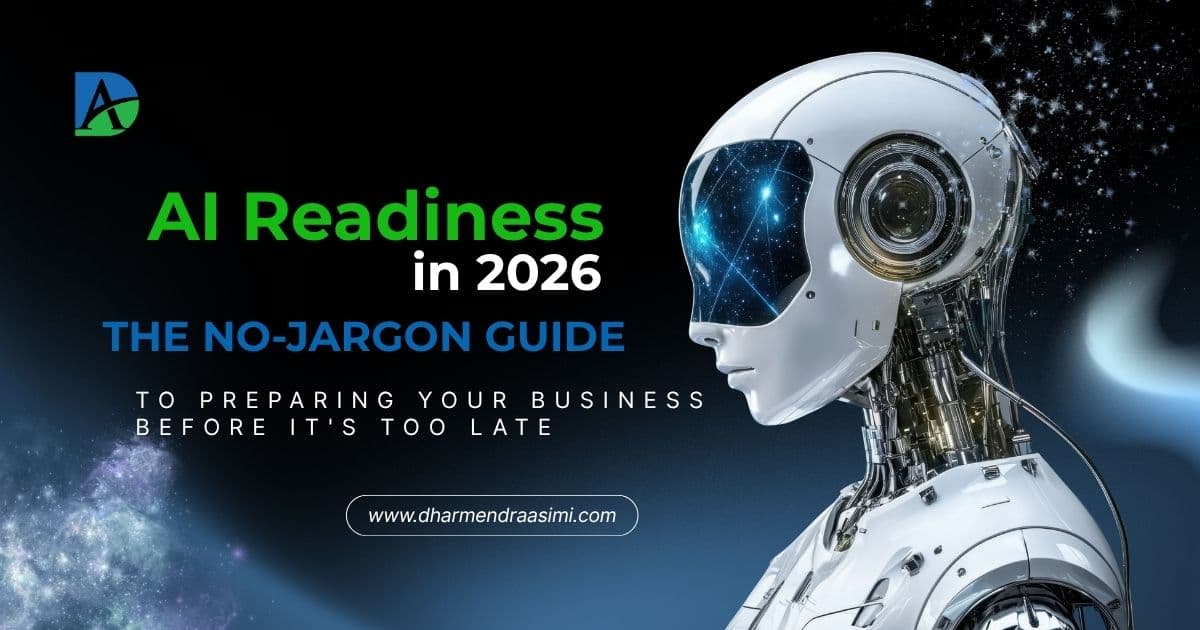
AI Readiness in 2026: The No-Jargon Guide to Preparing Your Business Before It's Too Late

Dharmendra Asimi
SEO Expert & WordPress Professional since 2005
Everyone is talking about AI. Your LinkedIn feed is drowning in it. Your competitors are posting about it. That new hire mentioned something about "prompt engineering" during their first week.
But here's the part nobody says out loud: most businesses have no idea how to actually prepare for AI. They know it matters. They just don't know what to do about it, beyond signing up for ChatGPT and hoping for the best.
That's where AI readiness comes in. And no, it's not just another buzzword. It's the difference between businesses that will use AI to grow and businesses that will spend the next three years watching their competitors do it first.
I'm writing this guide because every article I've found on AI readiness reads like a consulting whitepaper. Frameworks, pillars, maturity models, acronyms stacked on acronyms. That's useful if you're a CTO at a 10,000-person company. It's useless if you're running a 15-person agency, a growing eCommerce brand, or a solo consulting practice.
This guide is the plain-language version. What AI readiness actually means, what you need to do about it, and where to start today.
What is AI readiness, really?
AI readiness is your ability to use artificial intelligence effectively in your work. That's it.
It's not about building machine learning models. It's not about hiring a team of data scientists. It's about whether your business, your people, your data, your processes, your tools, is set up to actually benefit from AI, rather than just dabble with it.
Think of it like this. In 2005, "internet readiness" meant having a website, using email, and maybe accepting online payments. Businesses that got ready early dominated their markets. Businesses that waited got left behind. Some never recovered.
AI readiness in 2026 is the same inflection point. The businesses preparing now will have a structural advantage that compounds every year.
Other terms you'll hear for the same thing
The industry loves creating multiple terms for one concept. You might come across these, they all circle the same idea:
- AI maturity, Where you currently stand on the adoption curve (beginner, experimenting, operational, optimized)
- AI preparedness, Your readiness to integrate AI into existing workflows
- Digital transformation, The broader umbrella that includes AI adoption alongside cloud, automation, and data strategy
- AI governance, The policies and guardrails around how you use AI (ethics, bias, data privacy)
- AI literacy, Whether your team understands AI well enough to use it and make decisions about it
- Intelligent automation, Using AI to automate tasks that previously needed human judgment
Don't get hung up on terminology. The question behind all of these is the same: can your business use AI to do things faster, better, or cheaper than you're doing them now?
Why this matters right now
The numbers tell the story.
According to the Cisco AI Readiness Index, only 14% of companies globally are fully prepared to deploy AI. That means 86% are still figuring it out. The window to get ahead is open, but it's closing.
The AI Readiness Index 2024 ranks the United States first globally at 87.03, followed by Singapore (84.25) and South Korea (79.98). India ranks lower despite having one of the world's largest tech workforces. The gap isn't about talent. It's about organizational readiness, the systems, data, and processes that let AI actually work.
Here's the uncomfortable truth: AI doesn't help businesses that aren't ready for it. If your data is a mess, AI will give you faster wrong answers. If your processes aren't documented, AI can't automate them. If your team doesn't know how to work with AI tools, they'll either ignore them or misuse them.
Readiness comes first. Tools come second.
Not sure where to start?
Get a Free AI & Digital Strategy Consultation
15 minutes. No pitch. Just an honest assessment of where AI can help your business today.
Book a Free Call →The 6 components of AI readiness
Every framework out there slices this differently. Some have 4 pillars, some have 7, some have 12. After studying the major ones, Microsoft's, Cisco's, Gartner's, and working with real businesses, I've distilled it into 6 components that actually matter for small and mid-sized businesses.
1. Data readiness
AI runs on data. If your data is scattered across spreadsheets, random folders, someone's email inbox, and a CRM that nobody updates, AI can't help you.
What good looks like:
- Customer data in one place (a CRM, a database, or at minimum a well-organized spreadsheet)
- Sales and transaction data that's accurate and up to date
- Content and documents organized in a searchable system
- Historical data preserved, not deleted when someone leaves
What to do now: Audit where your data lives. Pick your top 3 most important datasets (customers, sales, content) and consolidate them. You don't need a data warehouse. You need clean, accessible, centralized data.
2. Process readiness
AI automates processes. But you can't automate what you haven't defined.
If your sales follow-up process lives in someone's head, AI can't take it over. If your content publishing workflow changes every week, AI can't optimize it. If customer support is handled differently by every team member, AI will just replicate the inconsistency.
What good looks like:
- Core business processes are documented (even if it's just a checklist in a Google Doc)
- Repetitive tasks are identified and acknowledged as repetitive
- Decision criteria are explicit, not tribal knowledge
What to do now: List the 10 tasks your team does every week. Star the ones that follow the same steps every time. Those starred items are your first AI automation candidates.
3. People readiness
This is where most businesses fail. They buy AI tools and nobody uses them. Or worse, people use them wrong and create problems.
52% of organizations say they lack AI talent and skills, according to industry surveys. But "AI talent" doesn't mean you need to hire machine learning engineers. It means your existing team needs to understand what AI can do, what it can't do, and how to work alongside it.
What good looks like:
- Leadership understands AI well enough to make informed investment decisions
- Team members can use AI tools (ChatGPT, Copilot, Claude, Gemini) for their daily work
- There's at least one person who stays current on AI developments and shares relevant updates
- People are curious, not afraid. The culture treats AI as a tool, not a threat
What to do now: Give your team 2 hours to experiment with AI tools relevant to their role. A marketer should try generating ad copy. A developer should try code completion. A customer support rep should try drafting responses. Let them discover the value themselves.
4. Technology readiness
Your existing tech stack either enables AI or blocks it. If you're running everything on paper and phone calls, you're not ready. If you have modern cloud-based tools with APIs, you're halfway there.
What good looks like:
- Cloud-based tools (not everything locked in desktop software)
- Systems that talk to each other (integrations, APIs, Zapier/Make connections)
- A website that's technically sound (fast, secure, well-structured data)
- Software that's kept updated, not running 5-year-old versions
What to do now: List every tool your business uses. Mark which ones are cloud-based and which have API access. If most of your tools are offline desktop apps, start migrating to cloud equivalents. This is foundational.
5. Strategy readiness
The worst AI strategy is "we should use AI for stuff." The second worst is "let's buy an AI tool and see what happens."
AI should solve specific business problems. If you can't name the problem, the AI tool won't help.
What good looks like:
- You can name 3 specific problems AI could solve for your business
- You have a rough timeline (what to try first, what to try later)
- Success metrics are defined (how will you know if it's working?)
- Budget is allocated (even a small one, most AI tools start at Rs.1,500 to Rs.5,000/month)
What to do now: Write down 3 sentences: "Our biggest time-wasting task is ___." "If we could automate ___, we'd save ___ hours per week." "Our competitors are using AI for ___." These three answers shape your AI strategy.
6. Governance readiness
This sounds corporate, but it matters for businesses of every size. AI governance means having rules about how you use AI.
Who checks AI-generated content before it goes to a customer? What data are you feeding into AI tools? Are you accidentally putting confidential client information into a chatbot? Are AI-generated images properly attributed? Does your team know not to blindly trust AI outputs?
What good looks like:
- Basic guidelines on what data can and can't be shared with AI tools
- A human review step for any AI output that reaches customers
- Awareness of copyright and IP issues with AI-generated content
- Understanding of AI bias and when to question AI recommendations
What to do now: Create a one-page AI policy for your team. Three rules is enough to start: (1) Don't put confidential data into public AI tools, (2) Always review AI outputs before sending to customers, (3) When in doubt, ask.
Real examples of AI readiness in action
Theory is one thing. Let me show you what AI readiness looks like across different business types.
A 20-person marketing agency
Before AI readiness: Writers spending 3 hours researching each blog post. Designers creating social media variations manually. Account managers copying data between 4 different tools. Monthly reporting taking 2 full days.
After getting AI-ready: Research time cut to 45 minutes using Claude for synthesis. Design variations auto-generated with Canva AI. Client data flowing through Zapier + AI processing. Reports auto-generated with key insights highlighted. Net result: 30% more client capacity without hiring.
A solo consultant
Before AI readiness: Spending hours on proposal writing. Manual scheduling back-and-forth. Generic follow-up emails. Slow content creation for thought leadership.
After getting AI-ready: Proposals drafted in 20 minutes with AI assistance (then refined personally). Automated scheduling with calendar AI. Personalized follow-ups generated from meeting notes. LinkedIn posts drafted weekly from AI analysis of industry trends. Net result: 10+ hours/week reclaimed for billable work.
An eCommerce brand with 5,000 products
Before AI readiness: Product descriptions written manually (taking months). Customer service overwhelmed with repetitive questions. Pricing updates done by hand across platforms. No personalized recommendations.
After getting AI-ready: AI-generated product descriptions reviewed by the team. Chatbot handling 60% of customer queries automatically. Dynamic pricing adjusted by algorithms based on demand. Personalized product recommendations increasing average order value by 18%. Net result: operating costs down 25%, revenue up 15%.
Free tools to assess your AI readiness today
You don't need to hire a consultant to understand where you stand. These free tools will give you a baseline:
Microsoft AI Readiness Assessment
Measures your organization across 7 pillars: Business Strategy, AI Governance, Data Foundations, AI Strategy, Organization & Culture, Infrastructure, and Model Management. It's thorough and gives actionable recommendations. Best for: businesses with 10+ employees.
Take the Microsoft AI Readiness Assessment
Cisco AI Readiness Index
Evaluates readiness across 6 dimensions: Strategy, Infrastructure, Data, Governance, Talent, and Culture. The best part is the benchmarking, it shows how you compare to peers in your industry and region. Best for: mid-sized businesses wanting competitive context.
Check the Cisco AI Readiness Index
Impact Maker AI Assessment
No account required. Takes about 8 minutes. Analyzes your business's digital presence and produces a prioritized report identifying your highest-return AI automation opportunities. Best for: small businesses and solopreneurs who want quick, actionable results.
Try the Impact Maker Assessment
WSI AI Readiness Assessment
20 questions that evaluate how well your business is equipped to leverage AI for real results. Simple, fast, and gives you clear next steps. Best for: businesses new to AI who want a starting point.
OvalEdge 50-Point AI Readiness Checklist
A free downloadable checklist that provides structured evaluation across all major AI readiness pillars with scoring guidance. Best for: teams who prefer a hands-on, self-paced approach.
Download the OvalEdge Checklist
How AI readiness is shaping the future
Let me be direct about what's coming.
In the next 2-3 years, AI will go from being a nice-to-have productivity boost to a fundamental operating requirement. Here's what that looks like across industries:
Search and discovery are changing. Google's AI Overviews already answer queries directly, reducing clicks to websites. Content cited in AI summaries gets 35% more organic traffic. If your content isn't structured for AI consumption (clear headings, factual claims, data-backed assertions), you'll become invisible in search results.
Customer expectations are resetting. People now expect instant, personalized responses at any hour. Businesses without AI-assisted customer support will feel painfully slow compared to competitors who have it. The bar has moved permanently.
Hiring is shifting. Companies are increasingly looking for AI-literate employees across all roles, not just technical ones. "Proficiency with AI tools" is appearing in job descriptions for marketers, salespeople, accountants, and project managers. If your team doesn't have these skills, hiring will become harder and more expensive.
Costs are diverging. AI-ready businesses are doing more with less. Their competitors are hiring more people to do the same work. Over time, this creates an insurmountable cost structure advantage. The AI-ready business can invest more in growth while spending less on operations.
Regulation is coming. The EU AI Act is already in effect. India's AI framework is developing. Businesses that establish governance now will adapt smoothly. Those that don't will scramble to comply under pressure, which is always more expensive and disruptive.
Your 30-day AI readiness action plan
Stop reading frameworks. Start doing these things:
Week 1: Audit
- Take one of the free assessments listed above
- List all your business data and where it lives
- Identify your top 5 most repetitive tasks
- Survey your team: who's using AI tools already? What for?
Week 2: Experiment
- Give every team member access to at least one AI tool (ChatGPT, Claude, or Gemini, all have free tiers)
- Challenge each person to use AI for one real task during the week
- Document what worked, what didn't, and what surprised you
Week 3: Organize
- Clean up your most important dataset (usually your customer/lead data)
- Document your 3 most important business processes
- Write your one-page AI usage policy
Week 4: Plan
- Pick 2-3 specific use cases where AI could save time or money
- Choose tools for each use case (start with free or low-cost options)
- Set a 90-day goal: "By [date], we will be using AI for [specific task]"
- Assign an owner for each initiative
Need help getting started?
AI Readiness & Technical Consulting
I help businesses assess their AI readiness, build implementation roadmaps, and integrate AI into their existing workflows.
Explore Technical Consulting →The biggest mistake businesses make with AI
They buy tools before they're ready.
I've seen businesses spend Rs.50,000/month on AI platforms they don't use. I've seen teams sign annual contracts for AI tools that nobody was trained on. I've seen companies integrate AI into customer-facing workflows without any review process, then wonder why customers are getting bizarre responses.
The tool is never the problem. The readiness is.
An AI tool in the hands of a ready business is transformative. The same tool in the hands of an unready business is an expensive subscription that gathers digital dust.
The bottom line
AI readiness isn't about being a tech company. It's about being a prepared company.
It's about having your data in order, your processes documented, your team curious and capable, your tech stack connected, your strategy focused, and your governance thoughtful.
You don't need to do everything at once. You don't need to hire an AI team. You don't need to spend lakhs on enterprise platforms. You need to start, methodically, practically, and soon.
The businesses that get AI-ready in 2026 will dominate their markets in 2028. The businesses that wait until 2028 to start will spend 2030 trying to catch up. This pattern has played out with every major technology shift for the past 30 years. The internet. Mobile. Cloud. Social media. AI is next, and it's moving faster than all of them.
Take the first step today. Run a free assessment. Clean up your data. Let your team experiment. The cost of starting is almost zero. The cost of waiting is everything.
If you want help building an AI readiness roadmap for your business, explore my technical consulting services or book a free 15-minute call. I'll give you an honest assessment of where you stand and what to prioritize first.
Enjoyed this? Get the next one in your inbox
Join readers getting practical guides like this every week. Free, unsubscribe anytime.
- One practical article a week, no fluff
- Free checklists and self-check PDFs first
- SEO, WordPress, AI search, and online safety