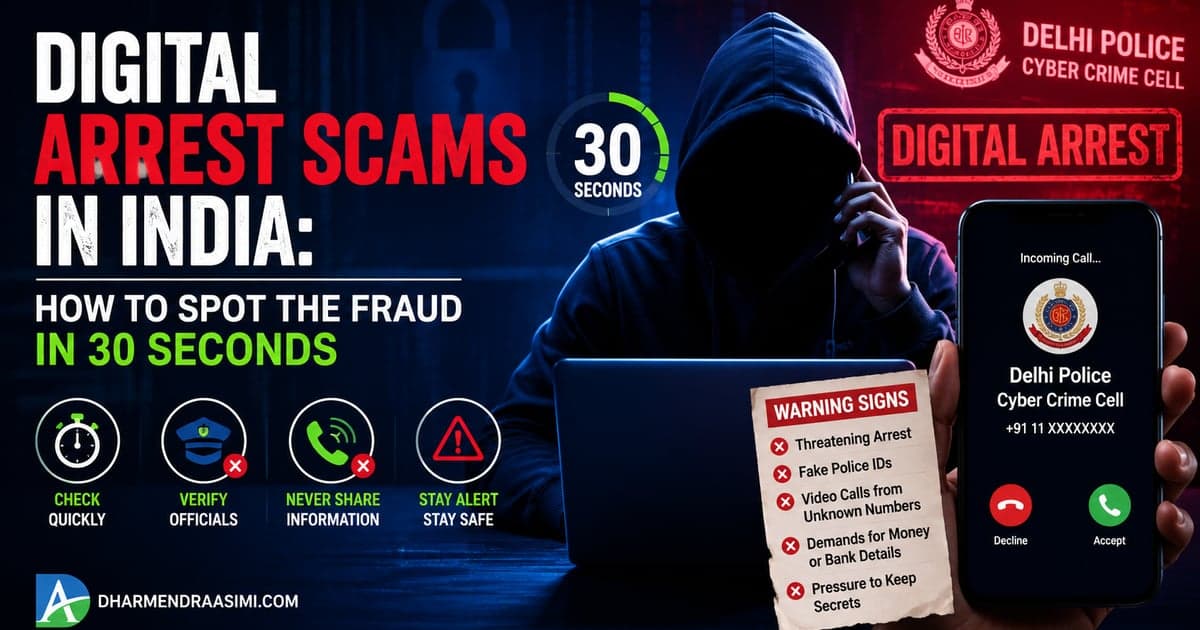
Digital Arrest Scams in India: How to Spot the Fraud in 30 Seconds

Dharmendra Asimi
SEO Expert & WordPress Professional since 2005

Cyber Kavach · Article 3 of 5
The self-defence series for your digital life. No jargon, no fear-selling. Free tools, clear steps, and checks you can run yourself in minutes.
In August 2024, the chairman of the Vardhman Group, one of India's largest textile companies, spent two days under the control of people he believed were CBI officers. They interrogated him over Skype, showed him a fabricated arrest warrant, conducted a fake virtual court hearing with a man impersonating the Chief Justice of India, and walked away with Rs.7 crore of his money. S.P. Oswal is not a naive man. He runs a business empire. The production was simply that convincing.
Now scale that down to a retired teacher in Mysore or your own parents at home on a Tuesday afternoon, facing a uniformed "officer" on a video call who has their full name, their Aadhaar number, and a warrant with their photo on it. This scam works because it is theatre built on fear, and it has become one of India's fastest-growing frauds, taking an estimated Rs.2,000+ crore of the Rs.22,495 crore India lost to cybercrime in 2025.
Here is the good news, and it is genuinely good: this entire scam collapses against one piece of knowledge that takes 30 seconds to learn. This article, the third in my Cyber Kavach series, gives you that knowledge, shows you the full anatomy of the fraud, and ends with the section I most want you to forward to your family WhatsApp group.
Short answer
Digital arrest does not exist in Indian law. There is no such legal concept, procedure, or power. Any call, video or voice, that says you are under digital arrest is a scam with 100% certainty, no exceptions. Real police and agencies like the CBI or ED never conduct arrests over video calls, never demand you stay on camera, never order you to keep an investigation secret from your family, and never, under any circumstance, ask you to transfer money to 'verify', 'settle', or 'protect' it.
If you are on such a call: hang up. Nothing happens to you, because there was never a case. If money has already moved, call 1930 within the first hour and file at cybercrime.gov.in, fast reporting can freeze the money mid-transfer.
What is a digital arrest scam?
It is impersonation fraud performed as a live show. Criminals pose as officials from the police, CBI, ED, narcotics bureau, customs, or TRAI, contact you by phone or video call, and accuse you of a crime you obviously did not commit. The accusation is designed to be terrifying and hard to disprove on the spot: a parcel in your name intercepted with drugs inside, your Aadhaar linked to a money laundering case, your phone number used in a human trafficking investigation.
Then comes the invented remedy. You are told you are under "digital arrest": you must stay on the video call, remain visible on camera, not contact anyone, and cooperate fully until the "investigation" clears you. Victims have been held like this for hours, and in the worst documented cases, for days or weeks, sleeping and eating on camera. The endgame is always identical: money must be transferred for "fund verification", a "refundable security deposit", or "settlement", into what are actually mule accounts that drain within minutes.
The Indian Cyber Crime Coordination Centre (I4C) and the Government of India have repeatedly and publicly stated: no agency in India conducts investigations or arrests through video calls, and none demands payment through them. The Prime Minister devoted a segment of his October 2024 Mann Ki Baat to exactly this scam, with a three-word protocol: ruko, socho, action lo. Stop, think, act.
🔵 Quick Stat
Digital arrest and similar impersonation frauds accounted for roughly 9% of India's cybercrime losses in 2025, which works out to about Rs.2,000 crore taken through pure theatre. Unlike hacking, nothing technical is breached. The only thing compromised is the victim's fear response, which is why awareness is the entire defence.
How does the scam unfold, stage by stage?
Nearly every reported case follows the same six-act script. Learn the script once and you will recognise it from the first line.
The hook. A call from "FedEx", "India Post", "TRAI", or "your telecom provider". A parcel in your name has been seized with drugs or fake passports, or your number is about to be disconnected for criminal misuse. Press 1 to speak to the authorities.
The transfer. You are "connected" to the Mumbai police, CBI, or ED. The new voice is stern and official. They confirm the case exists and say it is serious: money laundering, narcotics, human trafficking. Your Aadhaar is involved.
The theatre. The call moves to video. You see a uniformed officer, a police station set, wall crests, background radio chatter. They display a warrant with your name and photo, case files with real letterheads, sometimes a fake Supreme Court seal. It looks completely genuine. It is a stage set.
The isolation. You are told you are under digital arrest. Stay on camera. Do not leave the room. Do not tell family, friends, or your bank, "the case is confidential and tipping anyone off is a crime". This secrecy demand is the load-bearing wall of the entire scam.
The money. To "prove your funds are legitimate", you must transfer your savings to a "government verification account" or "RBI supervised account". It will be "refunded within 24 hours with a clearance certificate". Sometimes they walk victims through breaking fixed deposits and taking loans.
The vanish. The money hops through mule accounts and is withdrawn or converted within minutes. The "officers" keep you on the line as long as more can be extracted, then the call ends and every number goes dead.
What is the 30-second tell?
You do not need to evaluate the uniform, the warrant, the case number, or the officer's Hindi. You need exactly one fact:
🟡 The Only Fact You Need
"Digital arrest" does not exist in Indian law. Not in the old CrPC, not in the BNSS that replaced it, not anywhere. Arrests happen in person, with legal procedure and the right to a lawyer. So the moment a caller uses the phrase "digital arrest", the call has identified itself as a crime in progress. You are not deciding whether the officer is real. The concept itself is fake, which settles it instantly.
Four supporting tells, any one of which is disqualifying on its own:
- Police contacted you by video call. Real agencies serve notices in writing or come in person. Never video calls.
- You are ordered to keep it secret. Real investigations never forbid you from telling your family or calling a lawyer. Only scams need isolation.
- Money is requested. No agency on earth "verifies" your funds by having you transfer them. The instant money is mentioned, it is theft.
- Manufactured urgency. Everything must happen right now, on this call, before you can think. Real legal processes are slow on purpose.
🔴 Costly Mistake
Staying on the call to "clear your name" or prove your innocence. There is nothing to clear, because there is no case, no parcel, and no file. Every extra minute on the call is a minute of professional psychological pressure designed to move you toward the transfer. Victims consistently report they "knew something felt off" early but stayed on out of politeness and fear. You owe a criminal neither. Hang up mid-sentence.
Why are parents and elderly people the main targets?
This is the section to forward to your family group, because the numbers say your parents are more likely to face this call than you are.
Scammers deliberately target retired and older people for four reasons: a lifetime of respect for authority makes a "CBI officer" hard to defy, they are often home alone when the call comes, retirement savings sit in accessible bank accounts and fixed deposits, and they are less likely to have read an article like this one. Add the shame factor, many elderly victims tell nobody for days out of embarrassment, and the scam gets both its money and its silence.
Three protections, in order of power:
- Give them the one-liner. "Digital arrest is not a real thing. Anyone who says it is a thief. Hang up." That single sentence, delivered by a son or daughter, outperforms every government advisory.
- Set a family rule. No money moves and no "official call" continues until they have phoned you first, regardless of what the caller says about secrecy. The scam cannot survive one outside phone call. Agree on this out loud, today.
- Put the tools in their phone. Save 1930 in their contacts as "Cyber Fraud Helpline". Forward them the Scam Red Flags Pocket Guide, it is sized for a phone screen exactly so it lives in WhatsApp where they will look when it happens.
🟢 Pro Tip
Agree on a family code word. If anyone in the family is ever on a distressing call about police, kidnapping, or money (digital arrest scams and the related "your son is in custody" voice-clone scams both rely on panic), the rule is: ask for the code word or hang up and call back on the known family number. Thirty seconds to set up, and it defeats both scams and AI voice cloning at once.
How big is this, really?
The Oswal case made headlines because of the amount and the fake Supreme Court hearing, but the daily reality is thousands of smaller cases: pensioners losing Rs.4 lakh, teachers losing Rs.15 lakh, a family's wedding fund gone in an afternoon. India logged 28.15 lakh cybercrime complaints in 2025, and impersonation frauds like digital arrest sit near the top of the growth chart. Many operations run from organised compounds in Southeast Asia, staffed like call centres, complete with police-station sets, a fact covered in detail by The Hindu and repeatedly flagged in CERT-In and I4C advisories.
The government's response has scaled too: I4C has blocked lakhs of SIM cards and tens of thousands of devices linked to these operations, and the 1930 helpline plus cybercrime.gov.in now form a genuine rapid-freeze system. But enforcement chases; awareness prevents. Which is the entire point of this series, and the same reason I covered suspicious links and email compromise in earlier articles: the cheapest security is knowing the script before the call comes.
What if it is happening right now, or money already moved?
If the call is live: hang up. Do not announce it, do not negotiate. Nothing follows, no police arrive, because there was never a case. If you want reassurance, call your local police station's public number yourself and ask; they deal with these reports weekly.
If money has been transferred, the first 60 minutes decide most outcomes:
- Call 1930 immediately. The Citizen Financial Cyber Fraud Reporting system can freeze the money while it is still hopping between mule accounts. This is the single highest-impact action.
- File at cybercrime.gov.in with transaction IDs, screenshots, the numbers that called, and timestamps. Save the acknowledgement number.
- Call your bank's fraud line and request an immediate freeze and dispute on the transfers.
- Do not go quiet out of shame. Businessmen, doctors, and judges have fallen for this. Reporting fast is the only move that gets money back, and every report helps block the infrastructure for the next victim.
The Cyber Kavach series
This is article 3 of the opening season. The full run:
- Article 1: How to check if your email has been hacked, a free 5-minute self-check
- Article 2: How to check if your WordPress website is hacked, the DIY malware scan guide
- Article 3: Digital arrest scams in India (you are here)
- Article 4: Is this link safe? How to check any suspicious link before you click
- Article 5: UPI fraud in 2026, the 10 active scams and the 5-step safety setup
Frequently asked questions
What is a digital arrest scam?
A video-call fraud where criminals impersonate police, CBI, ED, or customs, accuse you of a fabricated crime (usually a parcel with drugs or Aadhaar misuse), claim you are under "digital arrest", isolate you on camera, and extract money as fund verification or settlement. The concept is entirely invented.
Is digital arrest real under Indian law?
No. It does not exist in any Indian law. Real arrests happen in person with legal procedure. The PM's October 2024 Mann Ki Baat and repeated I4C advisories state plainly: no agency investigates or demands money over video calls.
How do scammers make the call look so real?
Organised compounds with police-station sets, correct uniforms, forged warrants carrying your real details from data leaks, and even fake court hearings. Judge the claim, not the costume: real police never video-call you.
Why do they say a parcel with drugs was found in my name?
It is a frightening, unverifiable hook. Couriers do not call about criminal parcels and customs does not settle cases by phone. There is no parcel.
Who is targeted most?
Retired and elderly people, for their respect for authority, accessible savings, and daytime solitude. But professionals and business leaders have lost crores too. Teach your parents the one-line rule and set a family call-first protocol.
What do I do if I am on such a call right now?
Hang up. Nothing happens afterwards because there is no case. Report the number at cybercrime.gov.in or 1930.
I already sent money. Can I recover it?
Possibly, if you act within the first hour: call 1930, file at cybercrime.gov.in, and get your bank to freeze the transfers. Speed beats everything, including embarrassment. Report even late; freezes sometimes still catch the money.
How do I protect my parents?
The one-liner ("digital arrest is not real, hang up"), a family rule that no official call continues before phoning family, 1930 saved in their contacts, and the Scam Red Flags Pocket Guide in their WhatsApp.
Cyber Kavach · Free Resource
Download the Scam Red Flags Pocket Guide, phone-sized so it lives in your family WhatsApp group, right where it is needed when the call comes.
About the author
Dharmendra Asimi is an SEO Expert and WordPress Professional based in Bangalore, India. Founder of Aapta Solutions (established 2007), he has built and secured websites for hundreds of Indian businesses since 2005 and writes Cyber Kavach, the self-defence series for everyday digital safety. Read his full bio, explore technical consulting, or book a free 15-minute call. For the whole series and printable checklists, visit the Free Resources page, and if this article can save one family in your circle, tell me about it, those messages keep this series going.
Enjoyed this? Get the next one in your inbox
Join readers getting practical guides like this every week. Free, unsubscribe anytime.
- One practical article a week, no fluff
- Free checklists and self-check PDFs first
- SEO, WordPress, AI search, and online safety