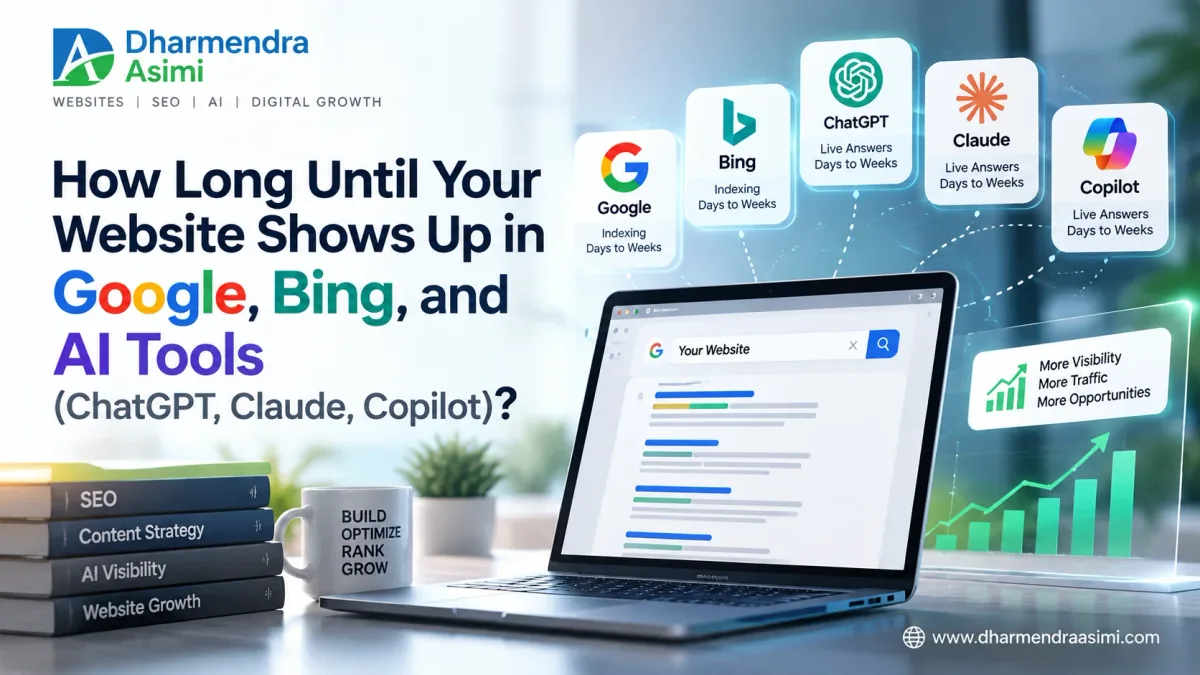
How Long Until Your Website Shows Up in Google, Bing, and AI Tools (ChatGPT, Claude, Copilot)?

Dharmendra Asimi
SEO Expert & WordPress Professional since 2005
This is the question almost every client asks within the first week of a launch or a relaunch: "It is live, so why can I not find it on Google?" And lately a second one rides alongside it: "Why does ChatGPT not know my business exists?" Both are fair. Both have real answers. And both are routinely answered with wishful nonsense online, so here is the honest version, backed by data.
The short version is that showing up is not one event, it is four different clocks ticking at four different speeds: getting crawled, getting indexed, getting ranked, and getting cited by AI tools. Confusing them is why people panic on day three or give up in month two. Let me separate them cleanly, then give you realistic timelines for a brand-new site, a redesigned or migrated site, and an old site you are only now pointing at the AI tools.
Short answer
A brand-new website typically gets indexed by Google in a few days to a few weeks, and by Bing in a similar window (faster if you use IndexNow). But ranking well takes far longer: Ahrefs found only 5.7 percent of new pages reach the Google top 10 within a year, so plan on 6 to 12 months for competitive terms and sooner for easy, local, and long-tail ones.
AI tools work on two separate clocks. Their live answers (ChatGPT search, Copilot, Claude web search, Perplexity, Google AI Overviews) can cite a page within days to weeks of it being crawlable and indexed, especially in Bing, which both Copilot and ChatGPT search rely on. Their trained-in knowledge is far slower: a new site may not influence a model's built-in memory until a future model is trained, 6 to 18 months out. An established, authoritative site opened up to AI crawlers can start appearing in live AI answers in days, not months.
The four clocks: crawling, indexing, ranking, and AI citation
Before any timeline makes sense, you need these four terms straight, because they are not the same thing and they run at different speeds.
- Crawling is a bot (Googlebot, BingBot, GPTBot) visiting your page and reading it. This can happen within hours of discovery.
- Indexing is the search engine storing and understanding that page so it is eligible to appear. Days to weeks. Being indexed does not mean you rank, it means you are in the race.
- Ranking is where you actually sit for a query. This is the slow one, driven by relevance, content quality, and authority built over months.
- AI citation is an AI tool naming or linking your page in an answer. For live-retrieval answers this tracks closely with being indexed and crawlable. For a model's trained-in knowledge it tracks with training cycles, which are measured in many months.
Most of the frustration I see comes from measuring the wrong clock. People check "do I rank number one" on day five when the only honest question that early is "am I indexed yet." So let us go clock by clock.
How long does Google take for a brand-new website?
Google's own John Mueller has repeatedly said that new or updated content can be indexed anywhere from a few hours to a few weeks, and that most good content is picked up within about a week, as covered by Search Engine Land. Delays usually come from technical problems or a site being brand-new with no links pointing to it yet, so Google has no reason to crawl it often.
Ranking is the different, slower clock. The most cited data here is Ahrefs' study of two million keywords (2017), which found that only 5.7 percent of newly published pages reached the top 10 for any keyword within a year. Of the pages that did break into the top 10, most took three to six months or more. Pages sitting at number one tend to be well over two years old. That is not a reason to despair, it is a reason to set the right expectation.
| Milestone (new site) | Realistic timeline | What moves the needle |
|---|---|---|
| First crawl | Hours to a few days | Search Console verification, sitemap, a few inbound links |
| Indexed | 3 days to 4 weeks | URL Inspection "Request indexing", clean HTML, no noindex |
| First rankings (easy/long-tail) | 1 to 3 months | Low-competition and local terms, helpful content |
| Competitive rankings | 6 to 12+ months | Authority, backlinks, topical depth, time |
To actually hit the fast end of indexing, do these on launch day: verify the site in Google Search Console, submit an XML sitemap, use the URL Inspection tool to request indexing on your key pages, make sure nothing is accidentally set to noindex, and get two or three real links pointing at the site so Google has a path in. A slow server or a JavaScript-only page that needs heavy rendering will drag all of this out, which is one reason I push clients toward fast, server-rendered builds. If speed is your bottleneck, that is a fixable problem, see my Core Web Vitals and speed fix service.
🔴 Costly Mistake
Launching with the "Discourage search engines from indexing this site" box still ticked (in WordPress) or a leftover noindex from staging. I have seen businesses wait two months wondering why Google ignores them, when the site was politely telling Google to stay away the whole time. Check this on day one with the URL Inspection tool, it reports exactly why a page is or is not indexed.
How long does Bing take, and why it matters more than you think
Bing deserves its own section now, because Bing is not just Bing anymore. Microsoft Copilot is grounded on Bing's web index, and OpenAI's ChatGPT search leans heavily on Bing too. So Bing indexing is the back door into two of the biggest AI tools. If you ignore Bing, you are not just missing Bing's search share, you are handicapping your AI visibility.
The good news is Bing can be the fastest engine to pick you up, thanks to IndexNow, a protocol Microsoft and Yandex launched in October 2021. IndexNow lets your site ping participating engines the instant a page is published or changed, instead of waiting to be crawled. Supported engines include Bing, Yandex, Seznam, Naver, and Yep. Google does not participate, so IndexNow is a Bing-and-friends tool, not a Google one. Pair it with Bing Webmaster Tools, which also has a direct URL submission feature.
| Engine | Typical indexing speed (new page) | Fastest lever |
|---|---|---|
| Hours to a few weeks | Search Console URL Inspection + sitemap | |
| Bing | Minutes to a few days | IndexNow + Bing Webmaster Tools |
🔵 Quick Stat
IndexNow notifications are often reflected within hours, not days, which makes Bing frequently faster to update than Google for fresh and changed pages. Remember the catch Search Engine Land notes: IndexNow guarantees the engine is notified, not that the page is indexed. It removes the discovery delay, it does not override quality judgement.
How AI tools actually get your content (and why the clock is split)
This is where most advice falls apart, because people imagine ChatGPT "learning" their website overnight. That is not how it works. AI tools pull from your site through two completely separate channels, and they move at wildly different speeds.
Channel one: live web retrieval. When you ask ChatGPT, Copilot, Claude, Perplexity, or Google a current question, the tool often searches the live web and cites what it finds. This is fast. If you are crawlable and indexed, you can be cited within days to weeks. This is the channel you can realistically influence this quarter.
Channel two: training data. This is the model's baked-in knowledge, set when the model was trained. A new site will not be in it until a future model is trained on a web crawl that happened after your content went up. Most training corpora draw heavily on Common Crawl, which refreshes roughly monthly, but getting into a crawl is not the same as a new model shipping. Realistically, training-data influence is a 6 to 18 month story, and only for content that gets referenced widely.
Here is who crawls what. OpenAI documents three separate bots: GPTBot (model training), OAI-SearchBot (surfacing sites in ChatGPT's search results), and ChatGPT-User (live visits when a person asks a question). Anthropic runs ClaudeBot, documented on its crawler support page. Perplexity runs PerplexityBot, per its bot documentation. Google uses Google-Extended as the control for AI training and Gemini grounding, explained in its crawler docs.
| AI tool | How it finds you (live) | Crawler to allow | Time to live citation |
|---|---|---|---|
| ChatGPT (search) | Own index + Bing | OAI-SearchBot, GPTBot | Days to weeks |
| Microsoft Copilot | Bing index | BingBot | Hours to days once in Bing |
| Claude (web search) | Live web search with citations | ClaudeBot | Days to weeks |
| Perplexity | Own crawl + web | PerplexityBot | Days to weeks |
| Google AI Overviews / Gemini | Google index | Googlebot (Google-Extended for AI) | Tracks Google indexing |
The pattern is obvious once you see it: get indexed in Google and Bing, and keep the AI crawlers unblocked, and you have covered the live-answer layer of every major tool. I go deeper on this in my piece on how Google AI Mode is reshaping traffic, and on the broader shift in why modern discovery runs through AI channels.
🟡 Did You Know
You cannot "submit" your site to ChatGPT or Claude the way you submit to Google. There is no AI equivalent of Search Console. What you control is access and clarity: allow the AI crawlers in robots.txt, serve clean HTML (not content locked behind heavy JavaScript), be present in Bing and Google, and publish an llms.txt file. The AI tools do the rest on their own schedule.
Scenario 1: A brand-new website or domain
This is the slowest scenario, because you are starting from zero trust. A new domain has no crawl history, no authority, and no links. Here is the honest arc.
- Week 1: Verify in Google Search Console and Bing Webmaster Tools, submit sitemaps, request indexing on key pages, set up IndexNow. Expect first crawls within days.
- Weeks 1 to 4: Core pages get indexed in both Google and Bing. You will start to see impressions in Search Console for your brand name and very specific long-tail queries.
- Months 1 to 3: Easy, local, and long-tail rankings begin to appear. Live AI answers may start citing you for niche questions where competition is thin.
- Months 3 to 12: Competitive rankings build as you earn links and publish depth. AI citation frequency grows with your authority.
- Months 6 to 18+: Possible influence on AI training data, if your content gets referenced widely enough to matter to the next model.
The single biggest accelerator for a new site is authority, which mostly means other credible sites linking to and mentioning you. A new domain with ten good links will outrun a new domain with zero every time. This is slow, deliberate work, and it is exactly the part people want to skip.
Scenario 2: A redesigned or migrated website
This one surprises people, because a relaunch can either be nearly invisible to search engines or a self-inflicted disaster, depending entirely on how you handle URLs.
Same domain, same URLs, new design: This is the gentlest case. Google re-crawls your changed pages over the following days to weeks and usually holds your rankings, as long as the content and internal links are preserved. A visual redesign that keeps URLs and content intact rarely causes more than minor, short-lived fluctuation.
Same domain, changed URLs: This is where 301 redirects become non-negotiable. Every old URL must 301-redirect to its new equivalent, or you throw away the authority those pages built. Google's own guidance on site moves with URL changes says to expect the move to take a few weeks to a few months to be fully processed, and a temporary ranking dip during that window is normal.
New domain entirely: Treat it as a migration plus a trust transfer. With correct 301s from every old URL, Google passes most of the old site's authority across, but it still takes weeks to months to settle, and you should keep the old domain and redirects live for at least a year.
| Redesign type | Recovery timeline | Risk level |
|---|---|---|
| New design, same URLs | Days to 2 to 3 weeks | Low |
| Changed URLs, clean 301s | A few weeks to a few months | Medium |
| Changed URLs, missing redirects | Months, often with permanent loss | High |
| New domain, clean 301s | Weeks to a few months | Medium |
🟢 Pro Tip
Before any migration, export a full list of your current indexed URLs and their traffic, then map each one to its new destination. After launch, resubmit the new sitemap, fire IndexNow for the changed URLs, and watch Search Console's Coverage and Page Indexing reports for spikes in 404s or redirect errors. A clean migration is boring, and boring is exactly what you want. If a relaunch is coming, my website migration service exists to keep it boring.
Scenario 3: An established site you are only now aiming at AI
This is the happiest scenario, and the most misunderstood. You have had a site for years, it already ranks, and now you want it showing up in ChatGPT, Claude, and Copilot. People assume this needs a long runway. It usually does not, for live answers, because you already have the two things a new site lacks: you are already indexed, and you already have authority.
Here the work is mostly removing blockers and improving extractability, not waiting. The steps:
- Check robots.txt first. Many sites unknowingly block AI crawlers. Confirm GPTBot, OAI-SearchBot, ClaudeBot, and PerplexityBot are allowed if you want AI visibility. Blocking them is a valid choice, but then do not wonder why you are absent from AI answers.
- Make content extractable. AI tools favour clean, server-rendered HTML with clear headings, direct answers near the top, and structured data. Content buried in heavy JavaScript or images is harder to lift.
- Stay in Bing. Because Copilot and ChatGPT search rely on Bing, an established site that has neglected Bing Webmaster Tools should fix that now.
- Add an llms.txt and solid schema. These give AI systems a clean map of what you offer and who you are.
- Publish answer-shaped content. Pages that directly answer real questions get cited more than pages that bury the answer.
Once those are in place, an established, trusted site can start appearing in live AI answers within days to a few weeks, because the retrieval layer already trusts and already finds you. The slow clock, your influence on a model's trained-in knowledge, still ticks at training speed, but you do not need to win that to get cited today. If you want this audited properly, that is exactly what my AI Search Visibility (GEO) audit checks end to end.
🔵 Quick Stat
The gap between a new site and an established one is largest in AI visibility. A new site might wait months to be cited with any consistency, while an established site with existing authority can show up in live AI answers within a week or two of being made crawlable and extractable. Age and authority compound in AI search even harder than in classic SEO.
The master timeline, side by side
Here is everything in one view, so you can set an honest expectation for your exact situation.
| Goal | Brand-new site | Redesigned site | Established site |
|---|---|---|---|
| Google indexed | 3 days to 4 weeks | Days to 3 weeks | Already indexed |
| Bing indexed | Hours to days (IndexNow) | Hours to days | Already indexed |
| Meaningful Google rankings | 6 to 12+ months | Weeks to recover, then as before | Already ranking |
| Cited in live AI answers | Weeks to months | Days to weeks after re-index | Days to 2 weeks |
| In AI training data | 6 to 18+ months | Next model cycle | Likely already, for older content |
How to speed every clock up, in order
If you do nothing else, do these, roughly in this order of impact.
- Set up Search Console and Bing Webmaster Tools on day one and submit sitemaps. You cannot manage what you cannot see.
- Request indexing on your most important pages through Google's URL Inspection tool, and enable IndexNow for Bing and friends.
- Fix crawlability and speed. Server-rendered HTML, a fast server, no accidental
noindex, a clean internal link structure so bots can reach every page. - Allow the AI crawlers in robots.txt if you want AI visibility, and add an
llms.txtplus proper schema markup. - Publish answer-shaped, genuinely useful content with the answer near the top. This is what both ranking and AI citation reward.
- Earn authority through real mentions and links. This is the slow compounding work that decides your ceiling in both search and AI.
None of this is magic, and anyone promising "instant Google ranking" or "guaranteed ChatGPT inclusion" is selling you something. What you can do is remove every avoidable delay and then let authority compound. If juggling all of this on top of running a business is the problem, that is precisely what a single accountable owner is for, whether that is my technology partnership for international teams or my Digital Partner retainer in India.
Frequently asked questions
How long does Google take to index a brand-new website?
Usually a few days to a few weeks. Google's John Mueller has said most good content is indexed within about a week, though it can range from hours to weeks. Verify in Search Console, submit a sitemap, request indexing, and link to new pages to hit the fast end. Indexing is not ranking, it only makes you eligible to appear.
How long before a new website actually ranks, not just gets indexed?
Months, not days. Ahrefs' 2017 study found only 5.7 percent of new pages reached the top 10 within a year. For a new domain, plan on 6 to 12 months for competitive terms, and 1 to 3 months for easy, local, and long-tail ones.
How do I get my website into ChatGPT, Claude, and Copilot answers?
Not by submitting directly. Make your site crawlable, allow the AI crawlers (GPTBot and OAI-SearchBot, ClaudeBot, PerplexityBot), and get indexed in Bing, which Copilot and ChatGPT search both rely on. For live answers that can mean days to weeks. Training-data inclusion is a separate, much slower clock.
Will redesigning or migrating my website hurt my rankings?
Only if you change URLs without proper 301 redirects. Same URLs with a new design usually recovers in days to a few weeks. Changed URLs with clean 301s take a few weeks to a few months to settle, with a temporary dip. Missing redirects is where lasting damage happens.
Can I submit my website to ChatGPT like I submit it to Google?
No. There is no AI equivalent of Search Console. You control access and clarity: allow the AI crawlers, serve clean HTML, be present in Bing and Google, add an llms.txt, and use schema. The tools pick you up on their own schedule.
Do I need to be in a model's training data to show up in AI answers?
No. Most current AI answers come from live web retrieval, which cites fresh pages. A page published this week can be cited this month, long before it reaches any training set. Training data mostly shapes a model's background knowledge, not its live citations.
How long until an established site shows up in AI tools after opening it to AI crawlers?
Often days to a few weeks for live answers, because the site already ranks and already has authority. The only slow part is influencing a model's trained-in knowledge, which waits for future model releases.
What is the single fastest way to get a page indexed?
For Google, the URL Inspection tool plus a clean sitemap. For Bing, Copilot, and ChatGPT search, IndexNow plus Bing Webmaster Tools. IndexNow often reflects changes in hours, though notification is not a guarantee of indexing.
About the author
Dharmendra Asimi is an SEO Expert and WordPress Professional based in Bangalore, India. Founder of Aapta Solutions (established 2007), he has run websites, SEO, security, and infrastructure for hundreds of businesses since 2005, including launches, migrations, and AI-search visibility programmes. He builds fast, crawlable sites that get indexed quickly and cited by both search engines and AI tools. Read his full bio, explore the AI Search Visibility audit, or book a free 15-minute call to talk through your launch, migration, or AI visibility.
Enjoyed this? Get the next one in your inbox
Join readers getting practical guides like this every week. Free, unsubscribe anytime.
- One practical article a week, no fluff
- Free checklists and self-check PDFs first
- SEO, WordPress, AI search, and online safety